
The elections bill is excellent for data on elections
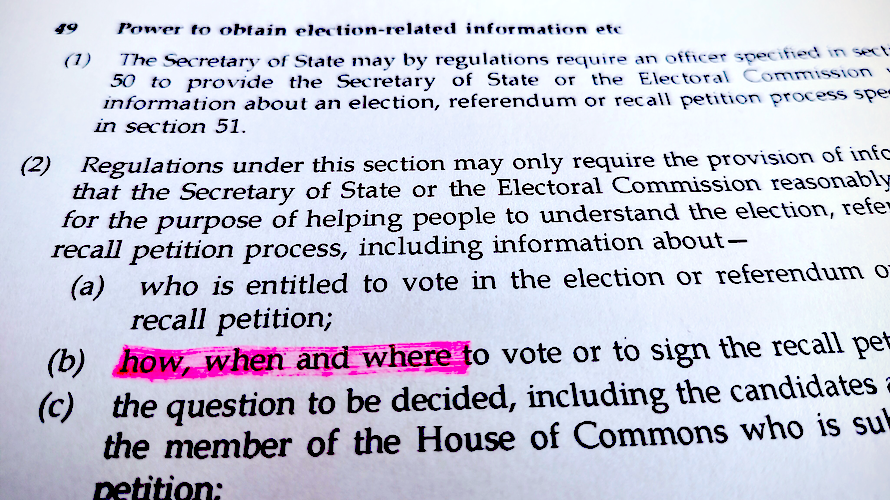
How, when and where; what we do for elections, but in primary legislation
Today the government announced Representation of the People Bill 2026 (also called The Elections Bill). Both MHCLG and The Electoral Commision have published their take on the bill.
The Bill follows on from the election strategy published last year. At the time we wrote up our thoughts on the strategy including some exciting talk about automated data collection from the software each council uses.
We’re excited that, along with many other headline-grabbing provisions, section 49 of the bill allows for the Electoral Commission to:
require the provision of information that the Secretary of State or the Electoral Commission reasonably requires for the purpose of helping people to understand the election, referendum or recall petition process
The information includes candidates, when and where to vote.
Importantly, 49(4)(a) and 49(4)(b) allow for The Commission to specify when this information is provided and the format it should be provided in.
This means, in theory, The Commission has the power to ask councils to provide a real-time API or open data publication in machine readable format, information about all elections including the date of poll, the candidates and polling station and the results.
These powers have the possibility to transform the way that election data works in the UK. It’s absolutely huge news in our tiny corner of election nerdery.
For the last 10 years or so, Democracy Club has been manually collecting information on elections, polling stations, candidates and results. We’ve been saying for years that this needs to be automated, with a clear vision for digital information about elections.
This bill creates a clear path to that happening.
Overall we are optimistic about these changes. We would like to think closely about how exactly they are implemented in order to avoid the risk of encoding the wrong thing, or being too rigid. Here are some specific areas we would like to work with the government to improve the bill:
More flexibility
Define outcomes not data, and allow The Commission to change the implementation details.
The worst thing that could happen here is that legislation (primary or secondary) could be far too rigid for the needs of the applications that consume it. It’s very possible for MHCLG and the Commission to write a statutory instrument requiring councils to publish data in a format that turns out not to be useful.
This means that the software vendors have to change their products and council staff have to change their processes, all because legislation says they need to, but all that work is for nothing if it’s not quite right.
We are very keen that legislation doesn’t get in the way of the ability to iterate a digital service in response to user needs. The power of the law is very welcome, but we think that The Commission needs the flexibility to specify what they need over time.
It would be better if the primary legislation defined the outcome and power were given directly to The Electoral Commission to deliver that outcome in the way it sees fit.
This is the pattern adopted by the Welsh Government; the Welsh Electoral Management Board (EMB) has the power to issue directions to returning officers that are legally binding. These directions can change over time, depending on the needs of the EMB.
Of course, some stability is needed for the software vendors to deliver working software and electoral service teams to put systems in place, so we would hope that any changes would be in good time and in partnership with the wider community. We still think greater flexibility is better than static regulations that are very hard to iterate.
It’s about more than Electoral Services teams
We need data from across the state in order to produce our services
If the Bill is limited to powers to request information from returning officers then we might miss some data that we need. Specifically returning officers don’t always hold the information in the time-frame that we need it.
When a boundary change happens, we need to get information from the appropriate boundary Commission. We do this manually by tracking boundary changes, rather than getting the information from electoral services teams.
Some of this is open data at the moment, but some things, like GSS codes, aren’t published in a way that allows us to use them. If the bill defined the actual intent (providing information online for voters) then The Commission would have a mandate to improve information flows beyond the data held by electoral services teams.
Improving the content
We need reliable IDs and error free by default
At the moment council software doesn’t store the identifiers we need, so we need to think hard about the content as well as format and mechanism of data transfer.
As things stand, we need to ‘fuzzy match’ ward and political party names. For full automation, we need to be able to add these IDs to council-provided data. If The Electoral Commission are too limited in their powers then we might end up automating the transfer of data, but still need humans to manually match the data to the IDs necessary for digital services. We hope the Commission will be able to provide some technical leadership around this without legislation, but giving The Commission a broad remit to define what ‘good’ looks like would be the most useful thing for the legislation to do.
We also need to consider what happens if the data councils provide is just wrong. Electoral Services teams are very diligent, but it’s not realistic to assume that no human error will ever happen. The Commission needs the ability to set standards and have a plan for dealing with data that’s inaccurate.
Other nations
Lastly, the nature of UK legislation is that it can’t compel the devolved nations of Scotland and Wales to do the same for their national or local elections. In practice this might not be an issue: the software vendors still work in those countries, so changes to add automation will be applied to them anyway. Electoral Services teams in Wales and Scotland will need to support this system for UK parliament elections (and recall petitions). In Wales, as stated above, there is already the ability to issue a direction to the same effect as this bill.
That leaves Scottish local and parliamentary elections without a current route to automation in law, but we hope they will follow suit in the near future.
To that end, we would welcome any feedback on how this data might be collected, or what needs there might be for it. For example, we know that broadcasters have very specific requirements for results data. It’s really important that we get a full picture on how the data might be used in order for the legislation to work properly.
We would like to work with the government on making this the best possible implementation it can be, and we hope this feedback is taken in the constructive manner it’s intended.