
Why are UK elections so different each year?
Have you bought your calendar for next year? Mark the first Thursday in May now!
The UK’s election calendar is confusing and constantly shifting. Why is it so difficult to tell people with confidence when their next election will occur? Here at Democracy Club we typically create the regular May elections in December or January. We’d love to be able to do this further ahead of time, but as this blog hopefully explains, it’s just not that simple!
Local and devolved elections in the UK traditionally happen on the first Thursday in May, what in legislation is termed the ‘ordinary day of election’. This is almost the only thing which unites the different election types.1 UK electoral law is split across dozens of statutes and is a devolved matter in Scotland and Wales. Differences range from electoral systems - there are currently five separate methods used across the various election types - to more minor areas such as the format of official notices. These differences also extend to timetables.
Scotland, Wales, and Northern Ireland: the best laid schemes
The arrangement of the electoral timetables in Scotland and Wales has largely been guided with an eye to avoiding clashes between different election types. ‘Combined elections’ are not popular among either politicians or electoral administrators, especially in cases where the electoral systems, laws, or returning officers differ. For example, local elections in Scotland were formerly held on the same day as the Scottish Parliament, but were decoupled in 2007 - one issue is that the returning officer for the Scottish parliamentary election may not be the same for a council election in the same area. Both parliament and council also used to be held on a four-year cycle, but were postponed in 2015 to avoid a clash with that year’s UK general election. In 2020 this break was formalised in the Scottish Elections (Reform) Act, and Scotland now operates entirely on a five-year cycle. The Senedd and Welsh councils also operate on five-year cycles, and are currently in lockstep with Scotland.
The Northern Ireland Assembly also holds elections every five years, and in 2016 all three devolved parliaments held elections on the same day. Achieving a perfectly synchronised devolved electoral calendar is impossible, however, because these elections can be held any time a government collapses. Following such a collapse in 2017, Northern Ireland has since fallen out of line with the other two nations, which is why its next elections are in 2027. The situation in Northern Ireland is further complicated by the fact that its councils are elected every four years, meaning that a clash with the Assembly is inevitable: in 2027, both will be elected on the same day (this has caused challenges for polling place arrangement, and we’ve been helping the Electoral Office prepare their polling station scheme for the big day).
England: going oft awry
Scotland, Wales, and Northern Ireland’s electoral timetables are simplicity itself compared with England.
English councillors sit for four-year terms, and English councils can choose their own electoral timetable. They can elect all their councillors at once every four years, or half every other year, or a third each year, with one ‘fallow’ year. Traditionally, district councils elect by thirds and county councils elect all at once in the district fallow year, meaning that many two-tier areas have elections each year. The Ministry of Housing, Communities and Local Government has attempted to keep track of all of this in one place, but this tracker does not go down to ward level (see below) and is updated infrequently. England also elects various local and regional mayors, which go to the polls once every four years but have their own timetables.
Elections by thirds are particularly finicky because not all wards have three members. This means that in a minority of council areas one ward with two members will not have an election, while all other wards will. To pick an example at random, of the sixteen wards in Hyndburn borough council, 13 have two councillors and three have three councillors. As a result, in each scheduled election four or five wards do not take part.
Any attempt to build a permanent English electoral calendar has to face three challenges:
1. English councils can change their own electoral timetable whenever they like - from thirds, to halves, to all-up and back again. This does not require parliamentary legislation (it’s a modification to the council’s constitution), so cannot be easily tracked in the way that parliamentary acts are.
2. Regular boundary reviews are conducted by the Local Government Boundary Commission for England. When this happens, the wards are redrawn and the council holds an election for all seats at once; councillors are then re-elected on the usual timetable. This means that even if a council elects by thirds, it will occasionally have an ‘all-up’ election, on a schedule published in legislation.
3. Local government reorganisation can throw the whole thing out of the window. Last year, for example, six county councils held elections outside of their usual cycle for this reason, while four new Mayoral Combined Authority elections were pushed back two years.
Recently, changes to timetables have occurred with only weeks to go before the official election period begins. In 2021, postponements were announced as late as 22 February, while one boundary review in 2020 did not come into law until 4 March. This makes the eight months’ notice we have been given of the abandonment of reorganisation plans for 2027 seem quite generous!
The consequence of all this is that although there are always some elections each year, the size and shape of them varies considerably. There is, however, a downwards trend in terms of the number of seats each cycle, as UK local government has been consolidated and centralised, resulting in larger councils with fewer councillors per area.
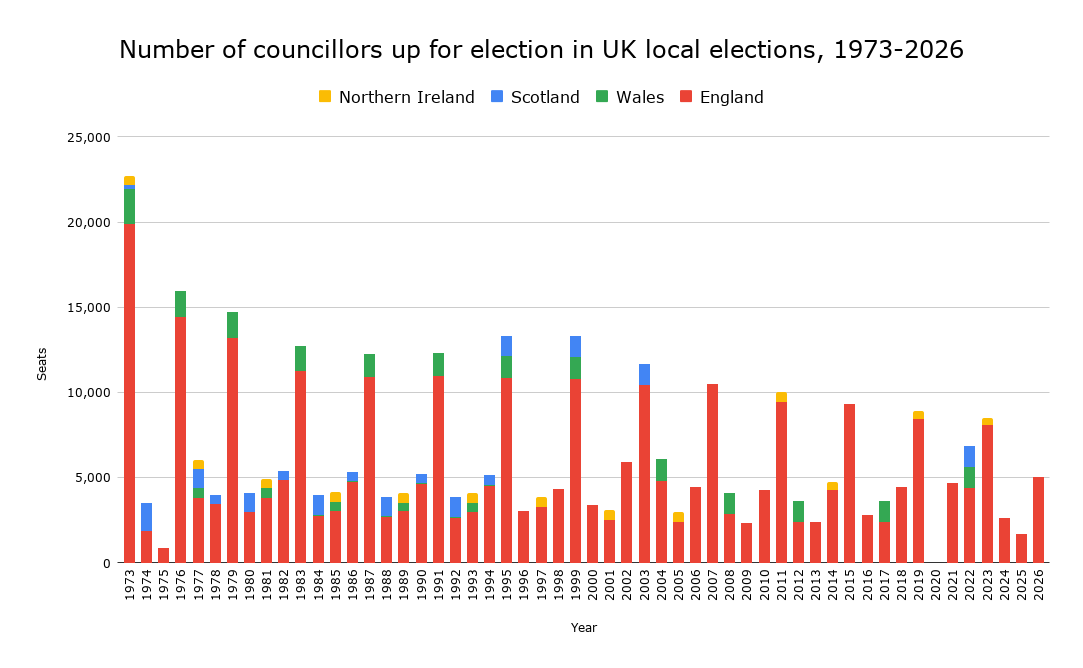
Data sources: Elections Centre; Wikipedia (Northern Ireland); Democracy Club.
2027: the convergence
2027 will see the largest set of council elections in at least two decades: currently 281 councils and around 10,500 seats across all four nations. This is because the largest year of English council elections and the election year for Northern Irish councils have converged with the five-year cycle of Scottish and Welsh councils, something which will not reoccur until 2047. On top of this, the Northern Ireland Assembly election is happening on the same day.
Candidate numbers have been rising recently, with more parties fielding larger slates across the country. If 2026’s candidate-to-seat ratio reoccurs, we could be looking at 50,000 candidates, comfortably the largest number Democracy Club has ever dealt with. We’ll be looking for help entering all this data: please sign up to our mailing list for more information in the near future.
🔄️
-
Regular readers of this blog will not be surprised to learn that the City of London does things differently, holding its elections in March. ↩