
English council boundary reviews on WhoCanIVoteFor
Out with the old, in with the new.
We’re pleased to announce a new feature on WhoCanIVoteFor.co.uk: council boundary changes. From now on, whenever an English council’s ward boundaries are modified, we’ll provide details about this to voters.
Boundary reviews
English councils are split into wards, each of which is represented by one or more councillors.1 The size and shape of these wards must meet certain requirements as set out in the catchily named Local Democracy, Economic Development and Construction Act 2009. All wards in a council area must have a similar councillor-to-elector ratio, so that no councillor is representing a disproportionately small or large electorate.2 Wards must also reflect the ‘identities and interests of local communities’, as well as ‘secure effective and convenient local government’: for example, the electoral cycle of a council should be taken into account when deciding how many councillors each ward has.
As populations change, the boundaries of wards need to change with them. The Local Government Boundary Commission for England (LGBCE) is the organisation responsible for reviewing and changing ward arrangements. Councils are reviewed when the LGBCE decides their population has changed enough to warrant it, or at the request of the council itself. This is a constant process: at time of writing, 36 councils are undergoing reviews. Almost all reviews result in changes of some kind.3
The review process is multi-stage, involving evidence gathering and the production of electorate forecasts, as well as a public consultation on the draft report. Once this is completed, the changes are written up as a piece of legislation called an Electoral Changes Order.4 Reviews typically take effect the next time the council has a scheduled election. If the council elects by thirds or halves, this next election will see all the councillors elected at once, with those having the fewest votes retiring first.
How reviews affect our work
Here at Democracy Club we run services which allow voters to look up their ward and candidates via a postcode search. In order to do this, we process boundary reviews as and when they are completed, so that when voters come to WhoCanIVoteFor they are given the correct ward details for their next poll. Hitherto, we have not made explicit mention of council boundary changes on the lookup. However, we think there is a good case to be made that this is core election information. We do occasionally get feedback from users who are confused that their ward has changed (or, more commonly, that we’ve told them the wrong ward, when in fact they are simply unaware of the changes).
From today, this is changing. Going forward, we will give users of WhoCanIVoteFor details about ongoing and recently passed boundary reviews. This decision was inspired by our work during the 2024 general election and 2026 Scottish and Welsh parliament elections, when we displayed information about changing constituency boundaries to users.
What we’ve done
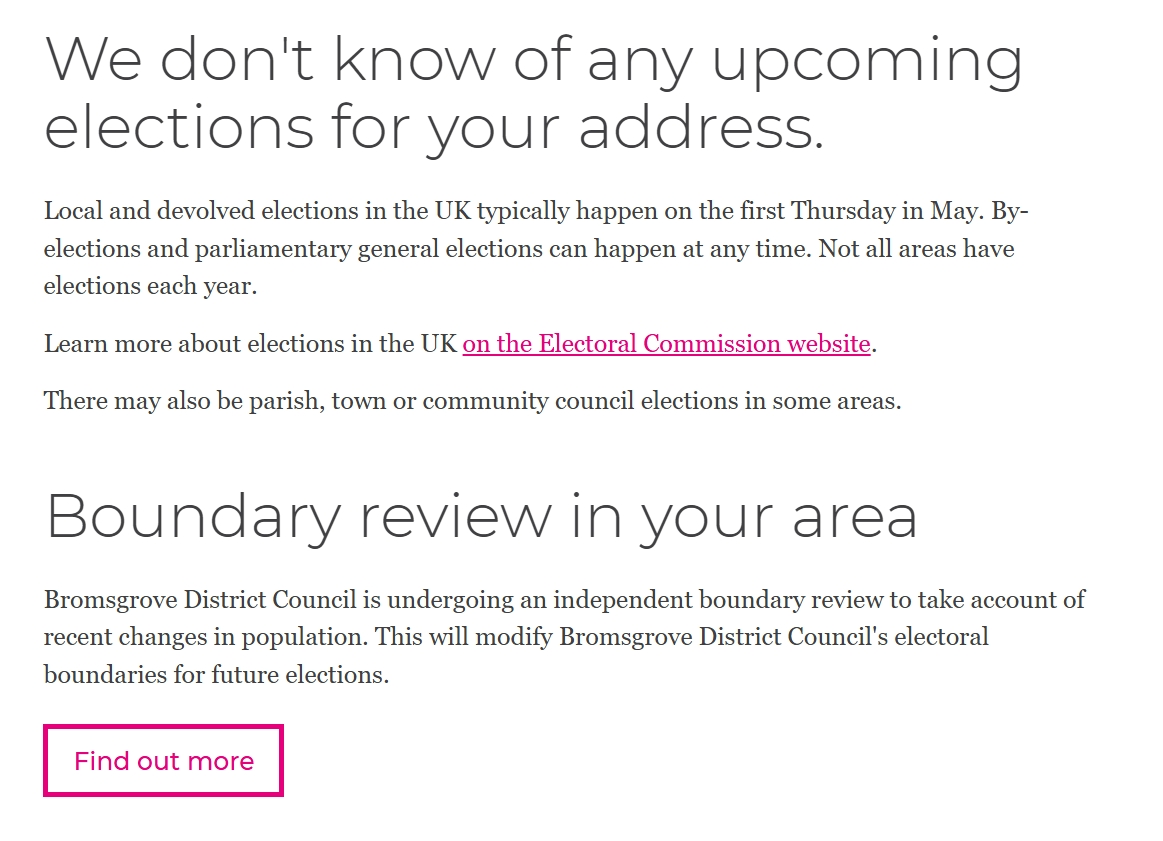
In the case of an ongoing review, we now provide a brief message and link out to the review, which in many cases will give the user the option to submit an opinion if the public consultation is ongoing.
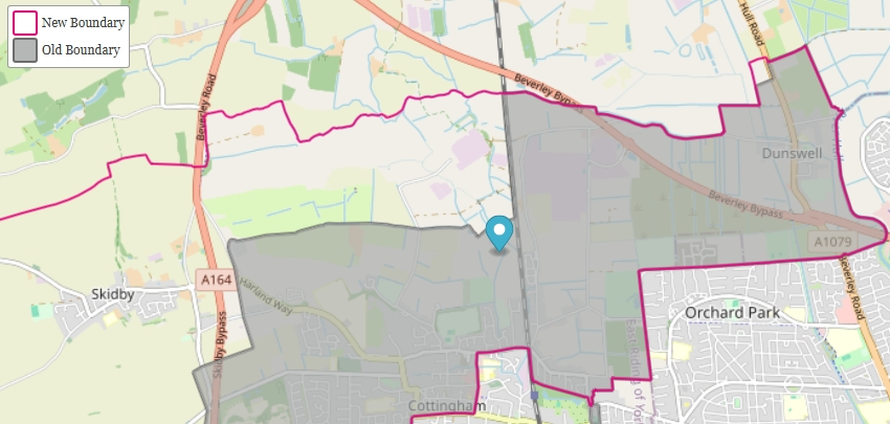
Where the review has been completed, we have attempted to summarise the changes to the voter’s ward on a new page of the site. We do not give information about the wider changes to the council beyond the elector’s ward, but we do provide a link to the review where they can get the bigger picture if they wish. The scenarios we’ve accounted for are any mixture of the following:
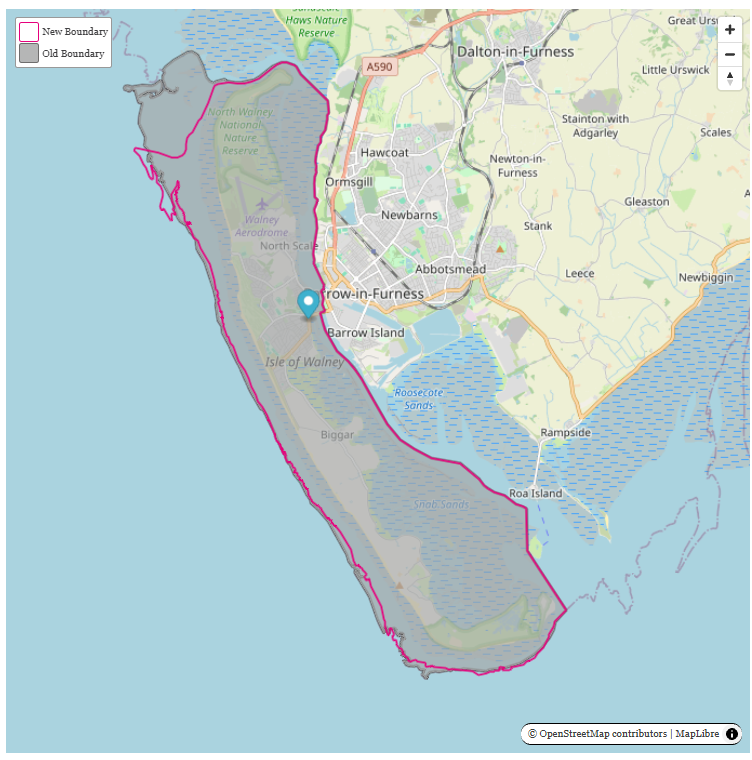
- The ward has not changed in any way, or has only minor boundary changes which do not affect any currently existing residential addresses.
- The ward has changed name, but not boundaries.
- The ward has changed boundaries, but not name.
- The voter has moved ward completely.
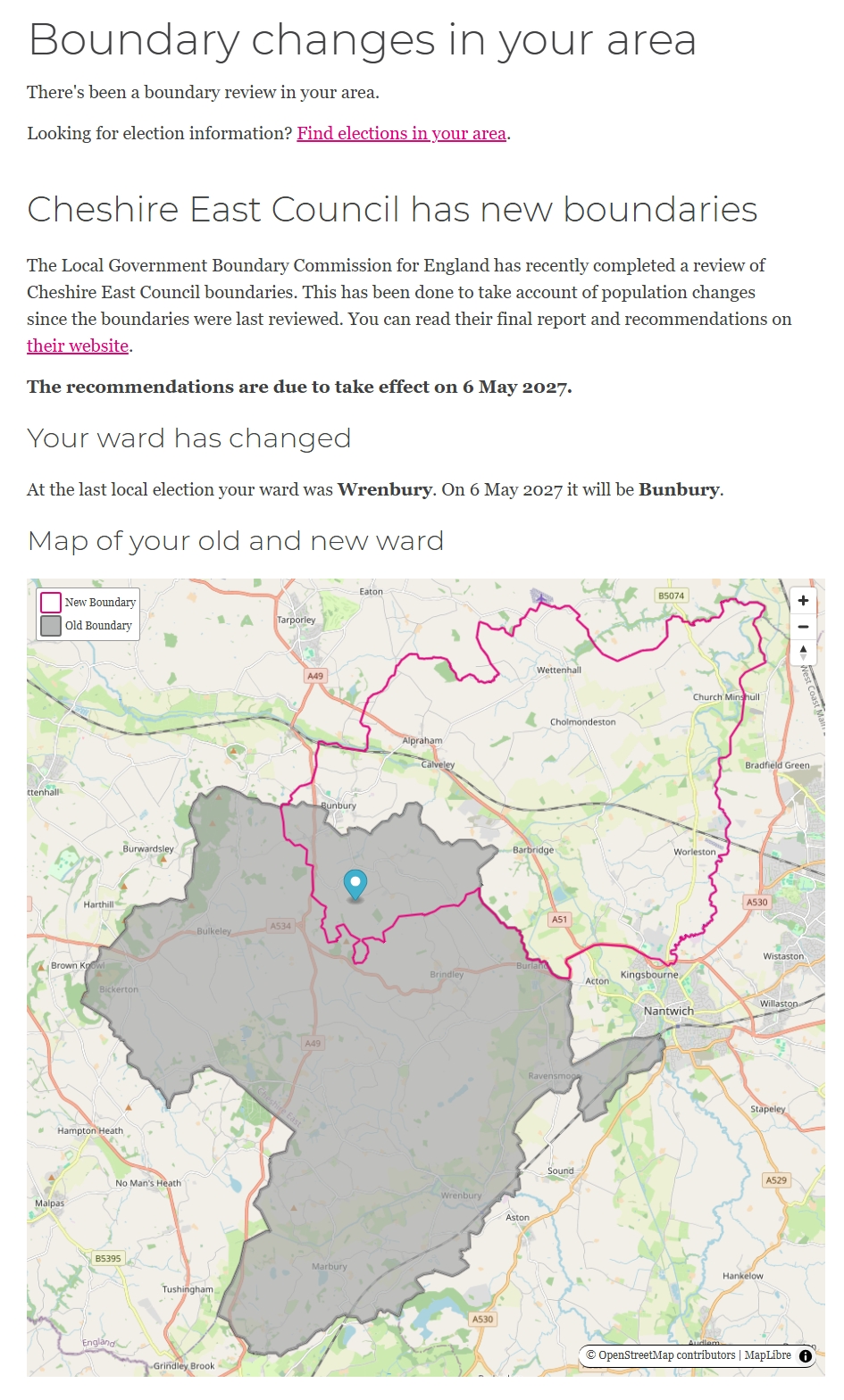
Links to boundary change information will be displayed to users of WhoCanIVoteFor in all affected council areas up until the completion of the first election run on the new boundaries.
When is a boundary change major or minor?
In our messages to voters, we have decided to tell them whether we think the changes to their ward have been ‘significant’. So how do we decide significance?
Comparing ward boundaries is not always straightforward; sometimes, boundaries can vary minutely based on the details of how the lines were drawn, such as if the cartographers decided to use the high or low water marks on the coast. We could try to determine when these differences are significant by setting a threshold of difference (e.g. > 5% larger or smaller), but it’s not easy to pick an arbitrary number as a catch-all.
We decided to instead compare ward boundaries using the addresses they contain. Our logic is: if an old and new ward contain the same residential addresses, then they are functionally the same for the purposes of grouping electors, even if the boundary lines aren’t identical.
Where to from here?
This feature is very much a work in progress and there are several directions we’d like to go with it.
One obvious next step is to expand the boundary changes we cover beyond England. The 2023 review of parliamentary constituencies in Northern Ireland performed by the Boundary Commission for Northern Ireland also affects local boundaries and the 2027 Northern Irish Assembly elections will be held on those modified boundaries. Further down the line, Democracy and Boundary Commission Cymru, which is responsible for reviewing boundaries in Wales, is due to undertake a review of the recently re-structured Senedd constituencies.
You may wonder why we haven’t mentioned Community Governance Reviews, boundary reviews that affect town, parish, and community council boundaries, and which occasionally affect local authority wards. We have a whole blog on why these are sadly out of scope for now.
Finally, with more local government reorganisation looming, we’d also like to cover Structural Change Orders; that is, legislation that creates, ends, or modifies local authorities. Although larger in scope, the work we’ve done to cover reviews should set us up nicely for communicating the changes made by this type of legislation.
Let us know what you think!
📐
-
In some councils wards are known as divisions. Ward is used throughout this blog for consistency. ↩
-
Note that wards are drawn up with reference to registered electors, not population. This is one of the many reasons why you should always be registered to vote! ↩
-
One current exception to this rule is the Isles of Scilly, whose electorate is projected to drop by precisely one person a year between now and 2031. ↩
-
Or, strictly speaking, an ‘(Electoral Changes) Order’. ↩