
2026 Local and devolved elections
This report provides an overview of Democracy Club’s work during the 2026 local and devolved elections. These elections marked our third time covering Scottish and Welsh parliamentary elections, and tenth time covering English local elections.
Summary highlights
- Over 10 million postcode searches over the election period.
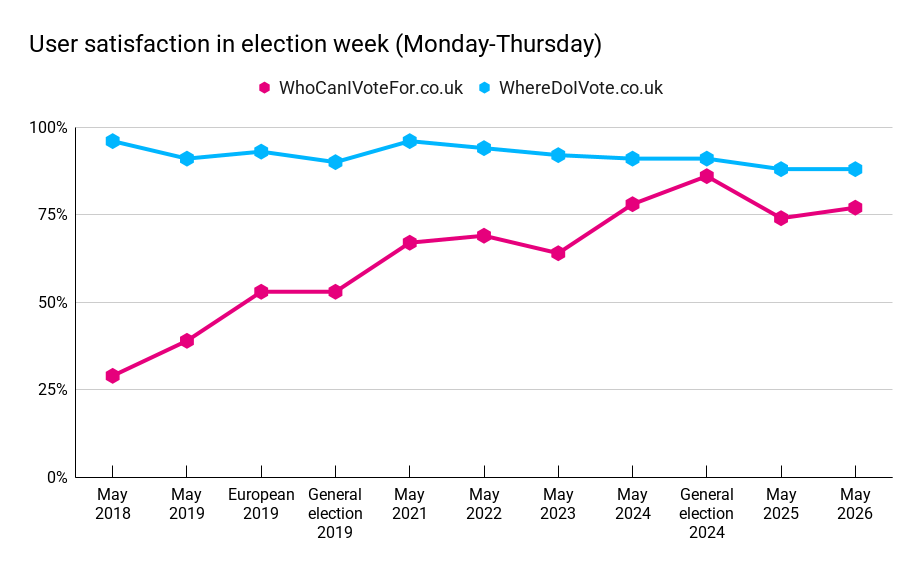
- 76% user satisfaction on WhoCanIVoteFor.co.uk (WCIVF) and 88% on WhereDoIVote.co.uk (WDIV).
- Modified our versatile polling station finder to include information about advance voting.
- Supplied polling station accessibility information to the official Welsh election information platform.
- Witnessed widespread use of our tools and election data, especially election results.
Election overview
The Scottish and Welsh parliaments and 136 English councils held elections on 7 May.
Compared to last year, this was a fairly hectic election for us. An increase in both the number of candidates and voter interest meant that there was considerably more to do on the candidates side of things than usual. Our work for the Welsh Electoral Management Board also added additional pressure (though of a straightforward and interesting kind). In the aftermath, our election results database was used widely by academics and researchers to analyse the outcome.
Postponed elections
Winter 2025/2026 saw considerable confusion over the status of many of these English polls. On 4 December the government decided not to go ahead with four Combined Authority elections. Then, on 22 January, polls in 30 English councils were postponed ahead of reorganisation. However, this latter decision was reversed on 16 February, as laid out in our blog. These decisions caused us some small difficulty. We had already created the mayoral elections, and took the decision to delete these entirely, as they would not now be happening until 2028. The council elections had been created in our system and marked as postponed (as we did in 2025); this was easily reversed. Overall the postponements did not significantly impact our election delivery, although it did generate a moderate amount of additional work for us in the form of more polling station data collection.
Data collection
Polling stations
220 GB councils were organising scheduled elections this year, and as has now become usual we had data from all of them, receiving the last file on 24 April. There were no significant issues, and the overall data quality was good. There were approximately 17,000 unique polling locations across the country on 7 May. 51.2% of stations were supplied by councils with location data attached which allowed us to draw a map for voters on the polling station finder - an increase over previous years.
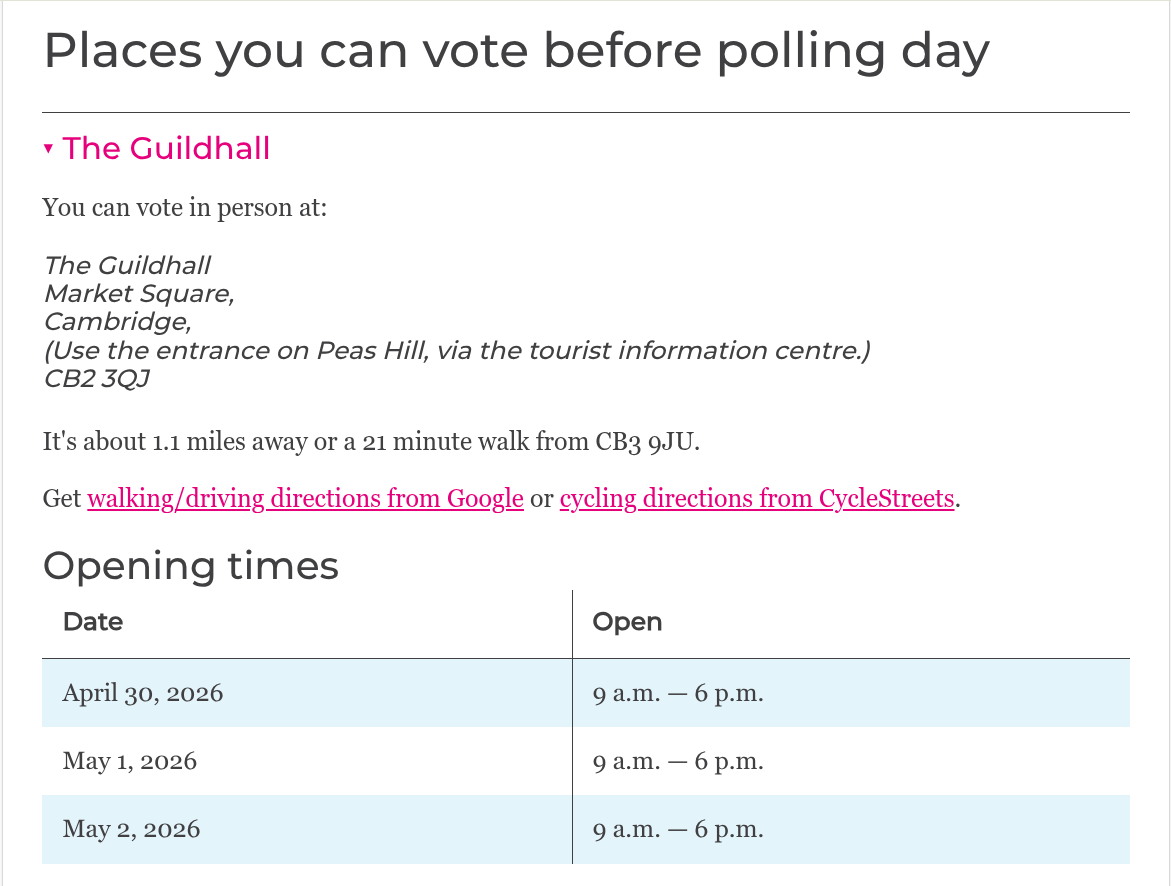
Four councils also held voting pilots this year, giving electors the opportunity to cast their ballot ahead of polling day (Tunbridge Wells, Cambridge, and North Hertfordshire) or at a central location on polling day (Milton Keynes). Working with the councils concerned, we provided voters with information about these pilots on our polling station finder (excluding North Herts, which only had parish council elections - we can’t cover these on our lookup. In the event, most were uncontested).
The Welsh Election Information Platform
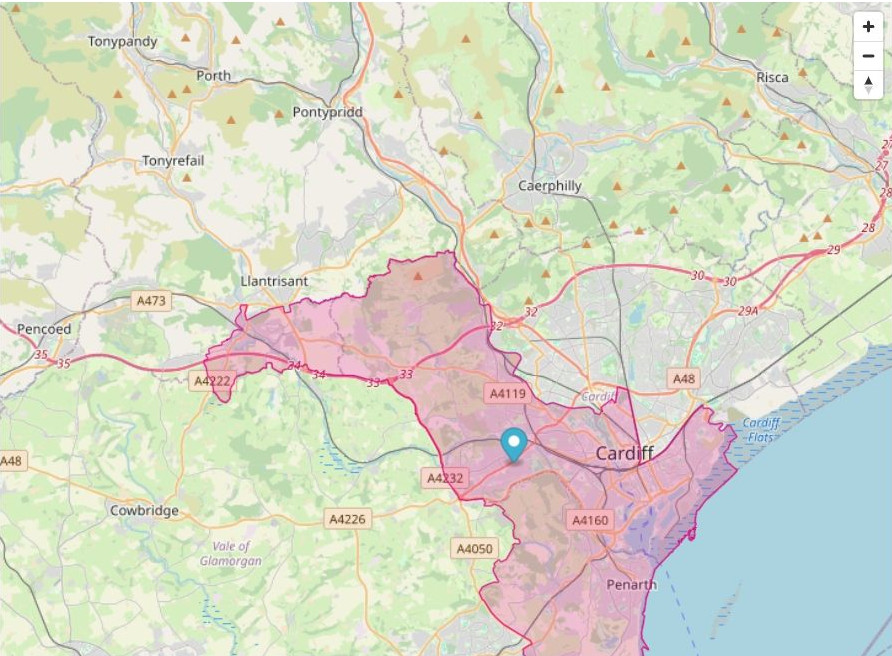
The Elections and Elected Bodies (Wales) Act 2024 required the Welsh government to establish a ‘Welsh elections information platform’, which, among other things, must provide voters with ‘information about accessibility arrangements that are in place at polling stations’. This launched in 2026 as Vote.Wales, run by the Electoral Management Board (EMB), part of the Democracy and Boundary Commission for Cymru (DBCC).
In order to meet this statutory requirement, the EMB turned to Democracy Club to provide a postcode lookup function, as well as accessibility information for each polling station. This was a complete success: by mid-March, all 22 Welsh councils had supplied accessibility data on their polling venues - 2,171 in total. This was the first time this data has been available for an entire UK nation. A write-up of this work is available on our blog.
Candidates
Candidate lists were published on 2 April in Scotland, and 9/10 April in England. We held an in-person data collection event in London on 9 April, which brought 10 attendees. This was a great success, and sped up our work while also introducing some new people to our database.
We also received some help from the BBC News elections team, who for the first time used our candidate database to populate the information they use for their projected national vote share (in terms of candidates, not votes).
25,000 candidates were nominated to stand in the English local elections. At 4.9 candidates per seat, this election shows that the high number of candidates which stood last year was not a one-off, and that five-party politics at the local level is probably here to stay.
When it comes to collecting information about each candidate, the sheer quantity of candidates puts new pressures on our ways of working - as indeed it also does for electoral services teams. We struggled to collect details from party websites, moderate the thousands of photos submitted, and evaluate requests to merge candidate profiles. We will think harder about how to solve these bottlenecks ahead of next year’s elections.
We also published our third dataset of parish council election results, working once again with Stuart Orford.
Scottish and Welsh boundary and electoral reforms
The Scottish Parliament held this election on new boundaries, which the Senedd adopted an entirely new electoral system. After our successful trial of boundary change maps at the 2025 general election, we decided to attempt something similar for the Scottish and Welsh polls.
Information about these changes was displayed on WCIVF. After a Scottish or Welsh postcode was entered, users could click the 'boundary changes' link in the page header to be taken to a map of their new constituency. We also took extra time to explain the changes to users, based on feedback from the GE, when many people were adamant we had them in the wrong constituency, as they hadn’t realised that the boundaries had changed. Our changes seem to have been a success - the confused feedback largely ended, and the Senedd information pages highlighted the map feature to voters. The next step will be trying this for council elections, perhaps in Scotland and Wales again for next year’s locals.
Volunteers and the Club
We retain a core group of amazingly dedicated users: 24 people contributed 500 or more edits over the course of the election.
Last year we wrote that we had seen a decline in the number of contributors to our candidate database. This year our in-person event (combined with help from the BBC) did much to improve the speed of data collection at close of nominations. We also saw an increased number of contributors to our election results database, including much-needed support from Compass and Make Votes Matter.
As mentioned above, however, we still struggled to get through all the photo uploads and candidate duplicate suggestions. We are going to be considering ways to improve this process over the coming year.
Evaluating overall reach and impact
Between 00:00 1 April, and 22:00 7 May, our elections database processed over 10 million postcode searches from the UK public. This is an unprecedented figure for a local or devolved election. Comparing election week searches, this outpaced the figures for the 2019 General Election by some margin.
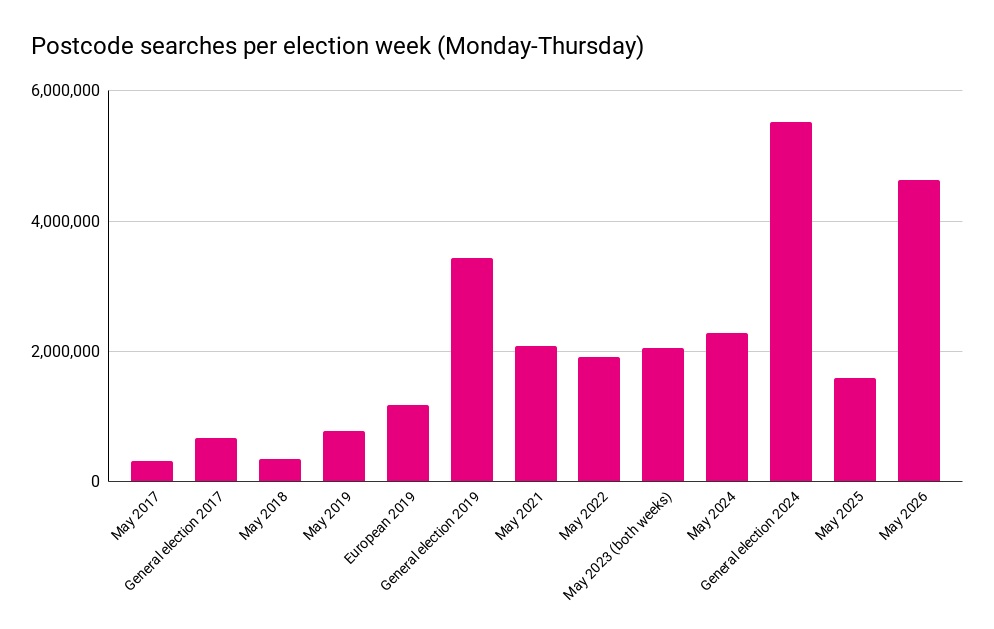
These searches split almost exactly 50/50 between our own services and those of our partners, such as the Electoral Commission, BBC News and WEIP.

WhoCanIVoteFor was once again shared widely by organisations as various as the Senedd, Inclusion London, and Ben and Jerry’s. Both of our websites were also used heavily by candidates and political parties.

Widget users
78 councils used our widget. Our star user was undoubtedly Future Surrey. This website was set up to inform voters about the county’s local government reorganisation, with two new councils created by merging together eleven district councils. By using our lookup the website was able to tell voters which council and ward they were in: and sent us 34,000 postcode searches, equivalent to 8% of the voters who cast a ballot in the county.
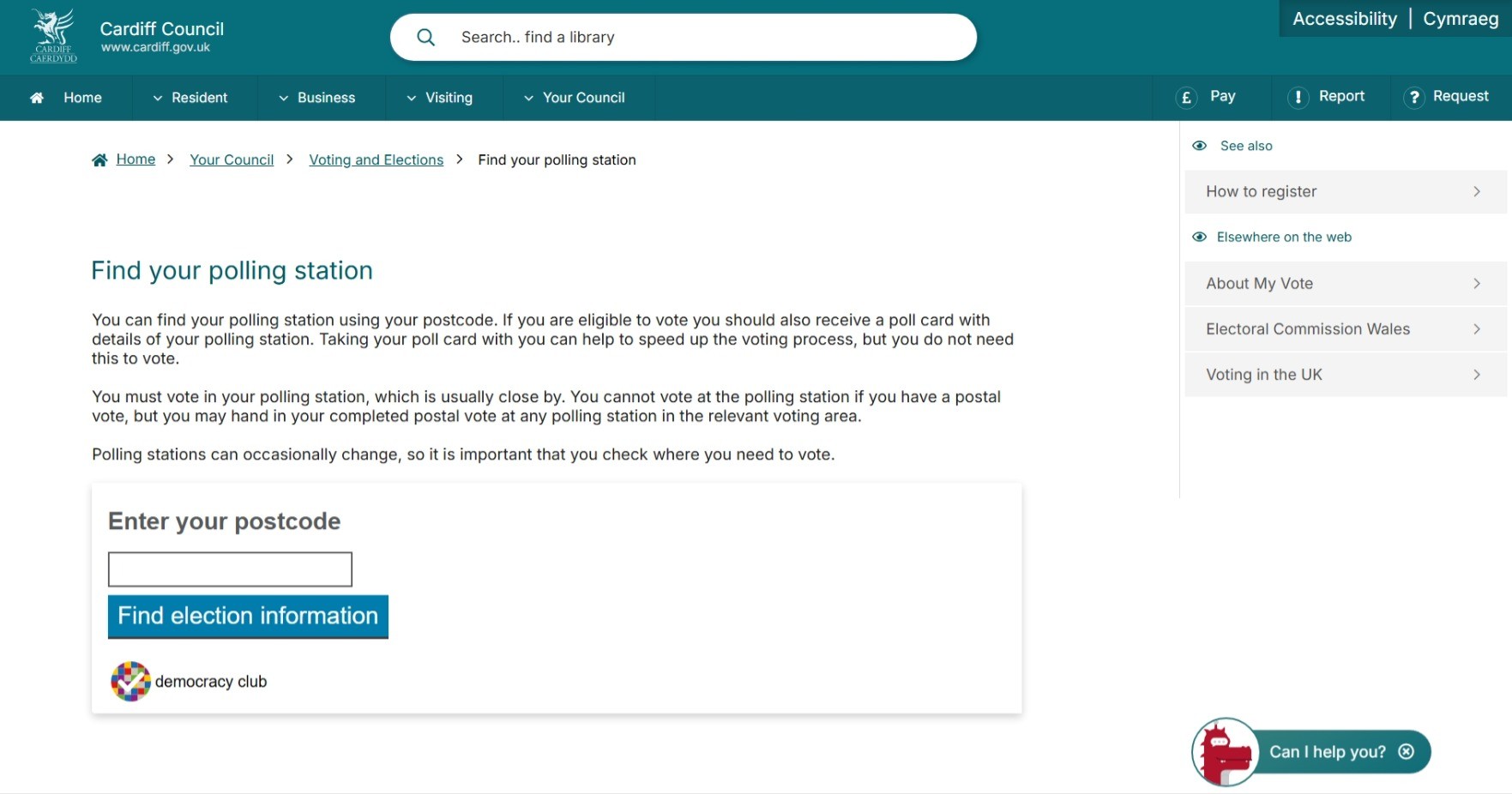
Other big widget users included The Times (19,000 searches), Cardiff council (14,000) and Bromley, Croydon and Wandsworth councils (10,000 apiece).
Did AI affect our traffic?
Loss of web traffic as a result of generative AI has been widely discussed. What we can say is that we have had no observable dip in traffic. In fact, we have possibly seen a slight increase, presumably because the kind of query we answer (‘where is my polling station?’) is difficult for an LLM to answer without sending the user a link to our polling station finder. ChatGPT appends a tracking parameter to its links, so we can see that it provided at least 2% of traffic to WDIV over the election period (and seemingly a negligible amount to WCIVF). Other LLMs either provided little to no traffic, or very rarely used trackers.
This was the first year that LLM training was an issue for our sites. We had to implement anti-bot systems to prevent crawlers from making millions of requests to our services. The biggest offender was Meta, who we saw making tens of thousands of duplicate requests an hour to WCIVF. Meta’s bot alone was responsible for small amounts of downtime on our candidate database. In future we need to find a way to block this irresponsible activity while supporting requests from humans using LLMs to find out about elections.
In the News
Democracy Club’s free and open data has been used extensively by journalists, campaigners and researchers this year.
Candidate gender was once again in the spotlight, with analyses of the number of women standing published in the Guardian and the results later analysed by Liam McLoughlin. Meanwhile our election leaflets database was extensively used by Full Fact in their election coverage. Earlier in the year the database was promoted by Professor Rob Ford in his coverage of the Gorton and Denton by-election.
Our results data has had a particularly successful year. We had collected all votes cast in the English local elections by Saturday evening after polling day, providing the most comprehensive open dataset in the UK. This was used heavily by campaigners - Make Votes Matter produced analysis and a postcode lookup tool, for example. Other uses of our election results database include an analysis of Multi-Level Regression and Post-Stratification (MRP) models, a study into the effect of political advertising, and a really nice study which maps deprivation and community need onto the results.
The blog
Democracy Club’s blog readership has grown significantly in the last couple of years, in part to more favourable Google search ranking. Our ‘what’s up for election?’ blog received 4,000 views; candidate data summary 13,000; and the final blog of the election, reflecting on the number of candidates and their manifestos, had a whopping 31,000.
User feedback
Last year user feedback fell as compared with the general election, and we fully expected the same to happen again: users are generally less satisfied with their options in local elections. However, with the number of candidates increasing, satisfaction on WCIVF rose slightly. 30% of WCIVF and 44% of WDIV users said that the service made them more likely to vote. Read more in our feedback blog.
Other projects
We don’t only work at scheduled elections! Here’s three highlights from our other work over the past year.
Polling district review
In mid-2025 Walsall council approached us about the possibility of using our polling station finder to assist them conduct a polling district review. We were extremely interested in this suggestion, and decided to give it a trial, modifying the finder to give electors information about proposed changes to their polling station. Walsall received 106 responses to their consultation, more than they were expecting. You can read more about this experiment on our blog.
The Electoral office for Northern Ireland
Over the last year we’ve established a fantastic working relationship with the Electoral Office for Northern Ireland (EONI), who are responsible for running all elections in the region.
EONI had two tasks for us. The first was simply to replace their polling station finder with our own, which we did. This differed from our usual work in that they wanted the finder to display stations all year-round, as well as differentiate between polling stations used for different elections.
The second task was to provide a mapping tool which would allow them to better understand how to manage their polling districts.This involved us building a site which will ultimately be provided to political parties and others to improve transparency over the electoral process. We’ve written up the project on our blog.
The Representation of the People Bill
The much anticipated Representation of the People Bill was published on 12 February. While the headline story was the granting of UK parliamentary and English local votes to 16 and 17 year-olds, there was much else in it besides. We’re excited that the Bill will provide the Electoral Commission with powers to obtain information from councils in order to run an elections lookup - an important aid for when they eventually take our polling station finder in-house.
However, we do think the Bill could be improved, though giving flexibility to the EC and by expanding the range of information published by councils in the first place. To this end we submitted evidence to the committee on the Bill, which you can read on Parliament’s website.
Thank you
Many thanks to everyone who has made this year a success: The Electoral Commission; electoral administrators and the Association of Electoral Administrators; The Electoral Management Board for Wales; BBC News elections team; and our amazing team of volunteer contributors.